Tuesday, January 19, 2016

Winter road trip in a Tesla Model S

I recently went on a 2500+ mile road trip from northern Colorado to Houston in my 2014 Tesla Model S85. It was yet another awesome road trip in a Model S. My road trip was in the last week of December 2015 and I was concerned about weather as well as energy consumption by the car. I was planning to drive I-25, I-70, I-135, I-35 and I-45. This route is well covered by Tesla superchargers and I had no concerns about being able to charge, but knowing how much charge I was going to need between superchargers was important since this route is subject to significant temperature variations and wind. Luckily my entire road trip fit in between two big storms. I caught the mess created after the end of one storm in northern Colorado on my way to Houston and caught the start of next snowstorm in northern Colorado on my way back.

I drive a RWD S85 with 19" wheels and I have Michelin X-Ice 3 winter tires on it. On my way to Houston, I-25 north of Denver was icy and snow packed. I left in the late afternoon and there were multiple accidents on I-25 due to road conditions. I had to find my way around these accidents and drive on icy/snowy side roads since traffic on I-25 was barely moving. High temp until Oklahoma was around 50F and low was in 10's and 20's. Temperature got up to 80F in Houston while I was there which was a treat coming from frozen Colorado :) On the way back, another snowstorm had started and my last half hour of drive was through snowstorm that dumped 5 inches of snow in little over two hours. Model S performed amazingly well through all these road conditions. I never felt even the slightest loss of control. For 20+ years before Model S, I had always driven FWD vehicles and was quite concerned about a RWD in Colorado. Not any more if it is a Model S!

Talking about energy consumption, I planned the segments between superchargers using evtripplanner. I have used evtripplanner for the last 2 years and I have found it to be quite accurate in its estimate of energy consumption. This held true for this trip as well except one segment where evtripplanner overestimated significantly. Other than that one segment, I consumed range miles that were within 10 miles of evtripplanner's estimate. Here is all the data on route, evtripplanner's estimates and actual range consumed:

- Tesla Model S85 RWD with 19" Michelin X-Ice 3 tires
- Speed: 3-5 miles above limit
- Interior temp: 72F
- Exterior temp: 20F-80F (<50F for 70% of the trip)
- Winds: <5 mph for most of the trip except in Kansas where it was 15-20 mph with 30 mph gusts at times (mostly head winds or blowing sideways)

Following maps show the route I took and the superchargers I stopped at. Below the map I have stats on energy consumption. Each entry shows the next destination, road distance, number of range miles estimated to be consumed by evtripplanner followed by actual number of range miles consumed.


  • Limon - 137 miles, 178 miles estimated, 186 miles actual
  • Goodland - 108 miles, 130 miles estimated, 116 miles actual
  • Hays - 142 miles, 188 miles estimated, 189 miles actual
  • Salina - 94 miles, 128 miles estimated, 131 miles actual
  • Wichita - 98 miles, 135 miles estimated, 130 miles actual
  • Perry - 93 miles, 127 miles estimated, 124 miles actual
  • Ardmore - 155 miles, 209 miles estimated, 212 miles actual


  • Denton - 69 miles, 95 miles estimated, ??? miles actual (forgot to record this one)
  • Corsicana - 101 miles, 122 miles estimated, 124 miles actual
  • Huntsville - 114 miles, 167 miles estimated, 142 miles actual
  • North Houston - 55 miles, 72 miles estimated, 59 miles actual

I followed the same route for the return trip except I decided to stop at Denver supercharger (by the airport) for a quick top off since temperature dropped significantly and it was already snowing. Weather conditions were about the same mostly except winds were down by 3-5 mph compared to earlier. I will start the stats for return trip from Huntsville supercharger:

  • Corsicana - 114 miles, 180 miles estimated, 136 miles actual
  • Denton - 101 miles, 128 miles estimated, 110 miles actual
  • Ardmore - 69 miles, 96 miles estimated, 86 miles actual
  • Perry - 155 miles, 212 miles estimated, 194 miles actual
  • Wichita - 93 miles, 131 miles estimated, 118 miles actual
  • Salina - 98 miles, 136 miles estimated, 144 miles actual
  • Hays - 94 miles, 139 miles estimated, 129 miles actual
  • Goodland - 142 miles, 210 miles estimated, 201 miles actual
  • Limon - 108 miles, 153 miles estimated, 153 miles actual
  • Denver airport - 76 miles, 103 miles estimated, 95 miles actual

Some notes:
  • I used a speed multiplier of 1.1, weight of 800 lbs and appropriate outside temp based upon forecast for each segment,  for all evtripplanner estimates
  • I drove 4-5 above limit normally except when speed limit was 75 mph when I drove 77-78 mph.
  • There is a steady climb from Salina to Denver with head winds often. Salina to Denver was the segment I was most concerned about regarding energy consumption. It went smoothly after I had estimates from evtripplanner.
  • Perry, OK supercharger is nowhere near as scary as has been reported on forums :) I stopped there around 9:00 pm with my wife and kids. It is very well lit and I never felt unsafe. The gas station by the supercharger looks run down from the outside but is nice inside with good restrooms.
  • Energy consumption is always higher in lower elevations. This was true when I was driving a hybrid car as well, so it didn't surprise me with Model S.

Tuesday, June 3, 2014

KitKat update for Samsung Galaxy Note 8.0 available

KitKat update for Samsung Galaxy Note 8.0 available now in US

I finally got a notification for KitKat update available for Samsung Galaxy Note 8.0 wifi model. Since the last update for Galaxy Note, battery life had taken a nose dive. The most I could get on standby was 2.5 days, so I was hoping KitKat update would improve battery life. I have updated to KitKat 4.4.2 today;


There are no immediately visible significant change in TouchWiz UI.  One minor change is the multi-tasking window now slides in from right instead of left on a swipe from right edge. I will see how long does the battery last with 4.4.2.

Wednesday, January 22, 2014

Dolby 5.1 sound on Amazon prime video

I recently signed up for Amazon Prime. I no longer subscribe to cable or satellite TV, so I was primarily interested in the Amazon Prime Video service. I have a Sony NSZ-GS7 Google TV box and a Sony SMP-N100 streaming box which can play video from Amazon. Google TV box is what is connected to my main home theater. Sony SMP-N100 is used for casual watching in family room. I use a Marantz SR6007 receiver as pre-processor and THX Ultra certified Denon AVR-4800 as amplifier. I have a 7.1 setup with KEF speakers primarily, except for Polk Audio bipole/dipole for surround back and Klipsch subwoofer. The gist of it is sound quality is as important to me as the video quality.

I fired up Google TV and started playing the movie "Skyfall". I got 1080p picture which is great but the sound was plain stereo! I double checked all cables, connections and settings but no 5.1 sound. I get 5.1 sound from Netflix on the same google TV just fine. I called Amazon and Sony and they both pointed fingers at each other. Since I was getting nowhere, I decided to move the Sony SMP-N100 box to the home theater and simply swapped google TV with this box. I fired up the same movie "Skyfall" again and voila, there was 5.1 sound. Looks like the Amazon app for google TV is picking the wrong audio stream. I called Amazon again and their response was pretty much this is how it is. So the Amazon google TV app has been handicapped in audio department for no good reason. What gives????

Thursday, January 2, 2014

My experiment to document vampire loss on Tesa Model S60

I recently went on a vacation for almost two weeks. Since I was going to leave my Model S60 in the garage, I decided to take advantage of this opportunity to document vampire loss while parked in unheated insulated garage. Here is what I did:

  1. Charge to 90%.
  2. Leave car plugged in and reduce charge limit to 70%. This way car would not do its normal topping off every 48 hours unless battery level drops below 70%.
  3. Run a script every 12 hours to get the battery level, rated and ideal miles using REST API. This, of course, did cause the car to wake up twice a day.
  4. I have CT sensor on the charging outlet and data from the sensor is recorded continuously, so I would know if car drew any power from the outlet.
Car was parked for 12 days and temperature in the garage was in lower 40s (deg F) the whole time. Data was collected roughly every 12 hours except initially when I was debugging the script and there were couple of times when script timed out before car woke up. Software version on my S60 is 5.8 (1.49.30). I plotted the data (click for interactive graph):


Battery charge level went down from 90% to 71% in 297 hours which translates to 1.5% per day. Range loss is less reliable data since it is subject to other variables besides just the battery charge level. Nevertheless rate of loss for rated range was 4.1 miles/day and for ideal miles was 4.6 miles/day. Over the entire 12 days car did not draw any power from the charging outlet.

Sunday, December 8, 2013

Vampire loss on Tesla S60 finally resolved

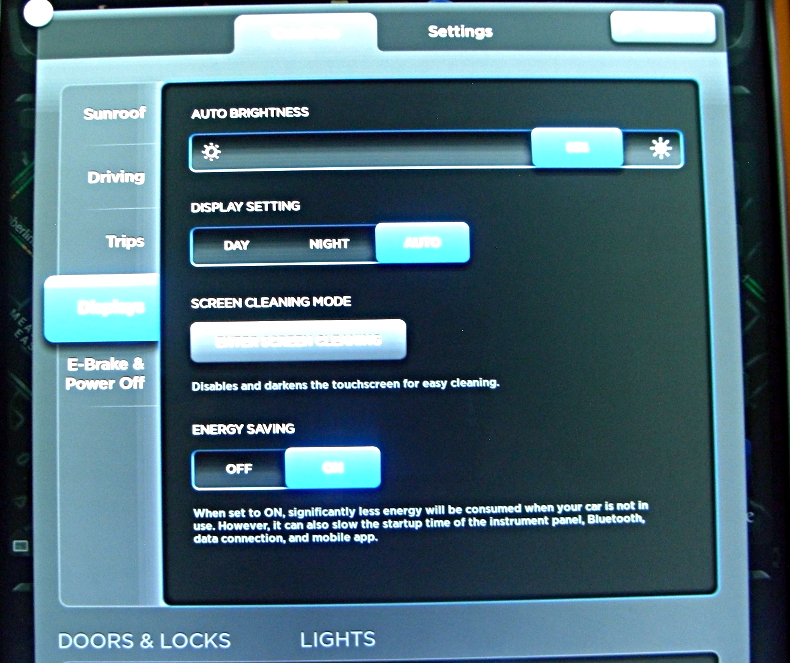
My Tesla Model S 60 kWh had been running software version 4.6 over the summer and I was seeing a vampire loss of about 7-8 miles every day. As winter started, vampire loss jumped to 15-17 miles per day. I had been waiting eagerly for version 5.x software to reduce vampire loss. I was finally upgraded to 5.6 and a week later to 5.8. My vampire loss was still in 14-16 miles per day range even though I had enabled energy saving on the display control screen:


I rebooted both the MCU (main screen) and instrument panel with no effect on vampire loss. I then tried another trick:

  1. Turn energy saving off. Reboot MCU by holding down both scroll wheels on the steering.
  2. After MCU comes back up, turn energy saving back on and reboot MCU again.
I started monitoring charge level and range using REST API after this and here is the data I gathered over 44 hours:

Current time: Fri Dec  6 12:04:37 2013
Outside Temp:    31.1 F     -0.5 C
Inside Temp:    35.6 F     2.0 C
Range:        149.47 Miles
Battery:    83.0 %


Current time: Fri Dec  6 20:11:04 2013
Outside Temp:    36.5 F     2.5 C
Inside Temp:    34.7 F     1.5 C
Range:        148.77 Miles
Battery:    83.0 %


Current time: Sat Dec  7 08:54:21 2013
Outside Temp:    32.0 F     0.0 C
Inside Temp:    31.1 F     -0.5 C
Range:        146.67 Miles
Battery:    82.0 %


Current time: Sat Dec  7 17:08:20 2013
Outside Temp:    34.7 F     1.5 C
Inside Temp:    32.9 F     0.5 C
Range:        143.51 Miles
Battery:    81.0 %


Current time: Sat Dec  7 18:35:54 2013
Outside Temp:    34.7 F     1.5 C
Inside Temp:    34.7 F     1.5 C
Range:        142.81 Miles
Battery:    81.0 %


Current time: Sun Dec  8 07:52:36 2013
Outside Temp:    33.8 F     1.0 C
Inside Temp:    34.7 F     1.5 C
Range:        141.4 Miles
Battery:    80.0 %
 This shows my car lost about 8 miles of range and 3% of battery charge over ~44 hours. That is significantly less than what I had been seeing. 4 miles per day is reasonable vampire loss considering how cold the temperatures have been. Range estimate takes temperature into account. On the other hand, looking at just the battery level, it lost only 3% over 44 hours which is in line with what I have seen with rechargeable batteries in various other devices.

From my point of view, toggling energy saving feature and rebooting in between seems to have solved the vampire loss problem on my S60.

Download script to get data using REST API here. This script works on a Linux machine from command line and is based upon a similar script written by David Mosberger.

Thursday, November 14, 2013

Ubuntu 13.10 problems with Cisco AnyConnect VPN

When I upgraded from Ubuntu 12.10 to 13.10, my VPN to Cisco AnyConnect stopped working. I use NetworkManager to initiate VPN connection. VPN connection would fail multiple times before connecting finally. Logs showed openconnect process simply exits with error code 1. Initially I thought the problem was with TLS support in the libraries since openconnect was also logging TLS failures in the log. So I replaced /usr/sbin/openconnect with a script that would invoke real openconnect binary with --no-dtls option but that did not help. I tried a workaround based upon a suggestion from a colleague and that worked. So here is the workaround:

Workaround

Initiate VPN connection from Network Manager. When the "Connect to VPN...." window comes up:


Double click on the connect button, instead of clicking it just once. This causes two instances of openconnect to be launched. Somehow at least one of them seems to not die. Now click on Login button as usual after it has established connection with the VPN gateway server. This also creates two VPN network interfaces but you can ignore that and look at the active connection in ifconfig -a output after VPN connection is established. If you have scripts that you run after VPN connection is established that do anything with the VPN network interface, you will need to adjust it since vpn0 may not be the active interface any more.

I have not traced openconnect process yet to see where it dies, but this workaround works reliably for now.

Wednesday, November 13, 2013

Tesla Model S software version 5.6 update (Update: now 5.8)

Tesla service updated my Model S software from 4.5 to 5.6. This has been a pleasant update. Some of the changes I really like are:
  • Automatic display brightness adjustment at dusk and dawn: I have my display mode set to auto switch between day and night modes. I keep my display at 50% brightness in day mode and 5% brightness in night mode. Prior to 5.6, at dusk and dawn the display will switch to night mode and 5% brightness when there was still quite a bit of light. That made 5% brightness too dark and not quite readable. This forced me to tweak the brightness level a few times until sun rose or set fully. With version 5.6, display brightness ramps up/down from one mode to the other at dusk and dawn. This keeps the display from being too dark or too bright at these times and it has been a pleasure to see the display at right brightness at all times without having to fiddle with controls. Great job on this feature from Tesla!
  • Status line on instrument panel: Status line at the bottom of instrument panel used small font and the background made it even a little harder to read it at quick glance. With 5.6, background has been improved and fonts are bigger. It is a whole lot easier to read now - 

  • FM Radio: FM radio screen has changed slightly. There is a button near the top to enable/disable HD radio. Fonts are thinner and sharper especially for the preset buttons. I like the minor enhancement overall - 


One of the major features of 5.6 was low power consumption mode when not driving, aka sleep mode. Unfortunately I have not yet seen significant benefit from this yet. Vampire loss seems to have gone down just a bit but not enough. On a cold night like last night when temperature dipped to 24 deg F (my car is parked inside an insulated but not heated garage overnight), I still lost 7 rated miles (or 8 ideal miles) overnight over a period of 11 hours. Car was plugged in the whole night.

Update (Nov 18, 2013): I had contacted Tesla about the vampire loss. They told me it should get better with 5.8. I got updated to 5.8 over the weekend. I checked overnight again. This time I lost 4 rated miles (5 ideal miles) overnight over 11 hours. So it is better, but not as good as 1-2 miles loss over 24 hours others had reported with 5.6.